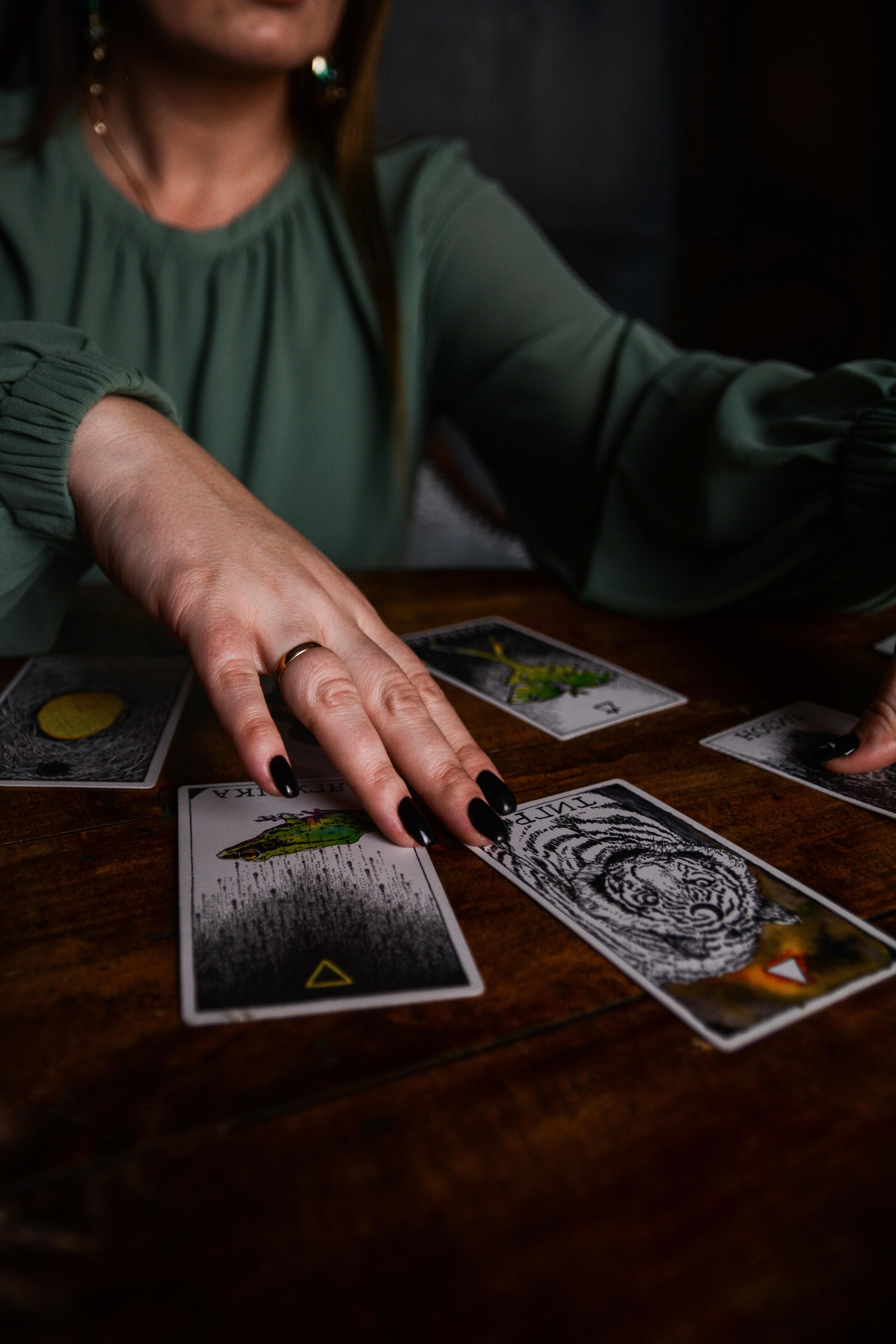
Something I notice often in therapy is that many people arrive having already decided which parts of themselves are allowed in. They bring the timeline, the symptoms, the history. The dream that keeps returning, the card they pulled this morning, the way the creek behind their house helps them breathe, all of that stays outside the door. They're worried they will be judged for being "woo", wyrd, or witchy.
Sometimes it slips in during the last two minutes of a session, with a small laugh. "This is probably silly, but..." or "You're going to think I'm weird, but..."
It is not silly. And maybe it is wyrd (good weird). But often it is the most honest thing they have said all hour, and it is a delightful peek into another world and way of being that moves them. Truly, it's an honor to be invited behind the veil/veneer that has been holding them back.
Sure, my practice is rooted in research. But it is also deeply connected to story, myth and the wild thread that connects us all: to the kinds of knowing that live in the body, in ritual, and in the living world around us. I don't think those two things are at odds with one another, because the world is just simply not that neat and organized. And a hallmark of science is its ability to say, ten toes to the ground, that we simply don't know everything there is to know Our ability to explain phenomena in the world with science doesn't make it any less magical; it just means that we become more adept at our craft of knowing and connecting.
“Any sufficiently advanced technology is indistinguishable from magic.” — Arthur C. Clarke
As a member of the Intuitive Clinicians Council, I welcome the parts of you that know things in ways science is still learning to name. If it fits your path, we can weave tarot imagery, ritual, time in nature, and other intuitive practices into our work alongside evidence-based care. You choose what belongs in the room, and together we make space for more of who you are and how you connect to the living world around you.
Rooted in research
Intuition is not the opposite of evidence. Researchers have studied intuition for decades, even if they rarely call it witchy. Here is some of what they have found:
Your body is part of how you know. In one study, people who could track their own heartbeat accurately showed a stronger link between their body's reactions and how intensely they felt emotions. In a second study, those bodily signals shaped intuitive choices in a card game, sometimes toward good decisions and sometimes away from them (Dunn et al., 2010). That nuance matters to me. Your "gut" intuition is information worth listening to and getting curious about. It may not always offers up the best advice or verdict, but I believe that therapy can help tune your intuition's effectiveness. Often we misperceive the signals, or have learned to quash them to fit in, and that's the source of feeling misdirected by our own Self.
Nature quiets the loop of rumination. Healthy adults who took a 90-minute walk in a natural setting reported less rumination afterward, and showed less activity in a brain region tied to it. People who walked the same distance through a city did not (Bratman et al., 2015).
Awe widens the frame. Older adults who took weekly 15-minute walks for eight weeks, and were invited to notice awe along the way, reported more positive, connecting emotions and less daily distress. Over time their selfies included more of the landscape and less of themselves (Sturm et al., 2022). I'm actually developing an online course to help people tap into awe in their daily lives, so be sure to sign up for my newsletter for announcements on launch day.
Ritual restores a sense of agency. After a loss, people who performed a ritual reported less grief, partly because it gave them a feeling of control. This held even for people who did not believe rituals work, and most of the rituals people described were personal rather than religious (Norton & Gino, 2014). Ritual has also been with us for millennia. Evolutionarily speaking, human beings survive and thrive on ritual.
Spirituality belongs in therapy when clients want it there. A review of 97 studies with more than 7,000 clients found that therapy adapted to clients' spiritual or religious beliefs improved both psychological and spiritual well-being (Captari et al., 2018). Most of those studies involved organized religions, but it extends to earth-based, pagan, and intuitive paths as well. Even though they are far less studied, it does not make them any less valid or important to people all over the world. Plus, there are deep roots to our ancestors in many of these practices, which can help us feel connected to something larger than ourselves, adding to the positive feelings of awe and belonging.
Open to the wild
These practices are not add-ons or party tricks. They are other doorways into the same work: understanding your story, tending your nervous system, and finding your way back to your own knowing.
- Tarot imagery. We might pull a card and ask what it stirs in you. In narrative therapy, we often step outside a problem story so we can talk with it instead of being swallowed by it. A card can make that step easier. I wrote more about this in Tarot as a Narrative Therapy Tool. My first tarot and oracle decks came through my Italian mother, so the cards have always felt like family to me. Years later, I trained with world-renowned intuitive imagery expert Dreya Blume, LCSW, on how to bring them into the therapy room with clinical care.
- Ritual. Marking a threshold: closing a chapter, highlighting a victory, drawing a boundary, honoring a loss, or beginning again. A letter written and released, a candle lit at the start of a hard week, a small act repeated with intention.
- Time in nature. Noticing the season you are in, finding a place you return to, or taking an awe walk between sessions. I explore this in Cultivating Awe. You'll also never be chided for taking sessions in your backyard or on the beach.
- Other intuitive practices. Dreams, moon cycles, dance, ancestral stories, and the other signals you have learned to trust or that bring meaning to your life.
Being part of the Intuitive Clinicians Council keeps me in conversation with other clinicians exploring this territory. It keeps me curious while holding onto the art, science, and sacred parts of therapy.
You choose what belongs in the room
None of this is required. Some of the people I work with never touch a tarot or oracle deck, and our work is no less deep for it. Others have been waiting for years to say the word "witchy" out loud to a therapist. They want to be seen as woo, and they delight in sharing their explorations and experiments with me. And I love it!
Here is what you can count on:
- I will ask before bringing in any practice, and check in on how it lands.
- You can set anything aside at any time, without explaining why.
- These practices sit alongside evidence-based care. They never replace it.
- I will not predict your future, diagnose through cards, or ask you to believe anything.
- If spirituality has been a source of harm for you, we go slowly, or we leave it out entirely.
For survivors especially, ritual and body-based work can stir things up. That is not a reason to avoid it. It is a reason to pace it with care, so that what opens can also be held.
Making room for more of you
Therapy isn't about becoming someone else. It's about having more room to live as yourself, and for some of us that self has always included candles, cards, creek water, and chatting with ancestors.
You don't have to choose between being rooted in research and being open to the wild. You can hold both. I do. And I would be honored to see and interact with these parts of you.
If this resonates, I'd love to hear what your knowing has been trying to tell you. Book a free 15-minute consultation, and bring whatever parts of you want to come along.
References
Bratman, G. N., Hamilton, J. P., Hahn, K. S., Daily, G. C., & Gross, J. J. (2015). Nature experience reduces rumination and subgenual prefrontal cortex activation. Proceedings of the National Academy of Sciences, 112(28), 8567–8572. https://doi.org/10.1073/pnas.1510459112
Captari, L. E., Hook, J. N., Hoyt, W., Davis, D. E., McElroy-Heltzel, S. E., & Worthington, E. L., Jr. (2018). Integrating clients' religion and spirituality within psychotherapy: A comprehensive meta-analysis. Journal of Clinical Psychology, 74(11), 1938–1951. https://doi.org/10.1002/jclp.22681
Dunn, B. D., Galton, H. C., Morgan, R., Evans, D., Oliver, C., Meyer, M., Cusack, R., Lawrence, A. D., & Dalgleish, T. (2010). Listening to your heart: How interoception shapes emotion experience and intuitive decision making. Psychological Science, 21(12), 1835–1844. https://doi.org/10.1177/0956797610389191
Norton, M. I., & Gino, F. (2014). Rituals alleviate grieving for loved ones, lovers, and lotteries. Journal of Experimental Psychology: General, 143(1), 266–272. https://doi.org/10.1037/a0031772
Sturm, V. E., Datta, S., Roy, A. R. K., Sible, I. J., Kosik, E. L., Veziris, C. R., Chow, T. E., Morris, N. A., Neuhaus, J., Kramer, J. H., Miller, B. L., Holley, S. R., & Keltner, D. (2022). Big smile, small self: Awe walks promote prosocial positive emotions in older adults. Emotion, 22(5), 1044–1058. https://doi.org/10.1037/emo0000876
P.S. I adore my Uusi tarot and oracle decks for their rich imagery and otherworldliness.